From Repetition to Revenue: How Parametric Design Tables Are Giving CAD Firms a Measurable Edge
For most architecture and engineering firms, the drafting floor has long operated on a familiar rhythm: a project arrives, standards are applied, elements are drawn, revisions accumulate, and the cycle repeats. Each project carries its own inefficiencies forward, quietly consuming hours that never appear on a project debrief but consistently erode profitability. What is changing that calculus—and changing it measurably—is the strategic deployment of AutoCAD's parametric design capabilities, specifically the use of intelligent design tables that transform static drawing elements into dynamic, reusable systems.
This is not a fringe practice. Across the United States, from mid-sized commercial architecture firms in Chicago to structural engineering consultancies in Houston, the adoption of parametric libraries built around common building elements is accelerating. The firms leading this shift are not simply working faster. They are compounding efficiency gains across projects in ways that fundamentally alter their competitive positioning.
What Parametric Design Tables Actually Do
At their core, AutoCAD's design tables allow users to define families of objects—window assemblies, curtain wall panels, structural grid configurations, door schedules—where dimensions, properties, and behaviors are governed by parameters rather than fixed values. A single block or object family can represent dozens or hundreds of variations, each accessible by modifying a defined input rather than redrawing from scratch.
This distinction matters enormously in practice. When a structural engineer needs to test three different bay spacing configurations across a 200,000-square-foot office building, a parametric grid system allows that exploration to happen in minutes rather than days. When an architect receives a client request to adjust the mullion spacing across a curtain wall system on the fifteenth revision, a properly constructed parametric library means that change propagates automatically rather than requiring manual updates across dozens of sheets.
The efficiency argument is intuitive. What is less often discussed is the quality argument: parametric systems reduce the category of error that arises from inconsistent manual updates, which is among the most common and costly error type in production documentation.
Building the Library: Where Firms Are Investing
The firms realizing the greatest returns from parametric design are those that made deliberate, upfront investments in library construction rather than attempting to parametrize on a project-by-project basis. The most productive areas for parametric development tend to cluster around elements that appear repeatedly across project types and carry significant revision risk.
Curtain Wall Systems
A regional commercial architecture firm based in Atlanta documented its experience building a parametric curtain wall library over approximately eight months. Prior to that investment, the firm estimated that curtain wall documentation consumed between 15 and 20 percent of total drawing production hours on mid-rise commercial projects, with revision cycles accounting for a disproportionate share of that time. Following library deployment across three successive projects, the firm reported a 40 percent reduction in curtain wall documentation hours and a near elimination of cross-sheet inconsistency errors during quality review.
The library was structured to accommodate standard panel dimensions, custom panel dimensions, varying mullion profiles, and spandrel configurations—all driven by a central parameter table that project teams could modify without touching individual geometry.
Window Schedules
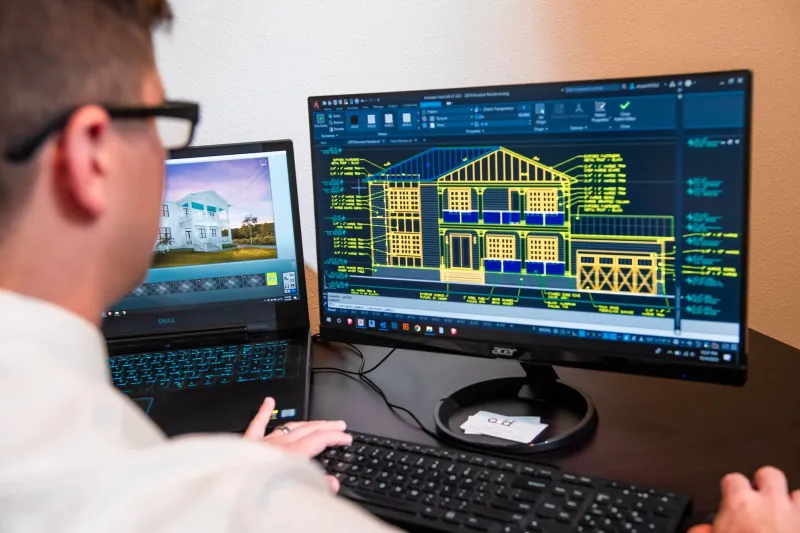
Window schedules represent another high-value target for parametric development, particularly for firms working in residential, multifamily, or hospitality sectors where window types proliferate across project documents. A Phoenix-based residential architecture practice built a parametric window family system that linked schedule data directly to drawing geometry, ensuring that any change to a window type in the schedule was automatically reflected in plan, elevation, and detail views.
The firm quantified the impact across a 120-unit multifamily project: revision coordination that had previously required two full drafting days was reduced to under four hours. More significantly, the system eliminated a class of error—schedule-to-drawing mismatches—that had generated contractor RFIs on two prior projects, each of which carried resolution costs the firm absorbed.
Structural Grids and Bay Systems
For structural engineering firms, parametric grid systems have proven particularly valuable during schematic and design development phases, when structural assumptions are still fluid. A Dallas-based structural consultancy developed a parametric bay system that allowed engineers to test span configurations, column sizing assumptions, and grid offsets interactively within AutoCAD. The system reduced the time required to produce comparative structural layout studies from three days to approximately six hours, enabling the firm to offer more thorough early-phase analysis without increasing fee structures.
The Compounding Return
Perhaps the most significant aspect of parametric library investment is the compounding nature of its returns. Unlike efficiency gains tied to individual workflow improvements, a well-constructed parametric library appreciates with use. Each project that draws on the library refines it—edge cases are addressed, additional configurations are added, and the system becomes progressively more robust.
Firms that have maintained parametric libraries over three or more years consistently report that the per-project efficiency gains increase over time rather than plateauing. This is a structural advantage that is difficult for competitors to replicate quickly, because the value of the library is embedded not just in the AutoCAD files but in the institutional knowledge of how those parameters were structured and why.
There is also a client-facing dimension to this advantage. Firms with mature parametric systems can respond to design changes with a speed and confidence that firms relying on manual drafting cannot match. In competitive project environments where client relationships are shaped by responsiveness, that capability translates directly into perceived value.
Implementation Considerations
Building a parametric library is not a trivial undertaking, and firms that approach it without adequate planning often find the investment difficult to justify in the short term. Several factors consistently differentiate successful implementations from stalled ones.
First, the scope of the initial library must be realistic. Attempting to parametrize every building element simultaneously is a reliable path to incomplete systems that teams distrust and abandon. Successful firms identify the two or three element categories that carry the highest revision burden and build those libraries first, allowing teams to develop familiarity with parametric workflows before the scope expands.
Second, the library must be maintained by someone with both technical authority and institutional standing. Parametric systems that are not actively maintained degrade as projects push them in directions they were not designed to handle, and undocumented workarounds accumulate. Assigning library stewardship to a senior technical staff member—rather than treating it as an administrative task—signals organizational commitment and ensures the system evolves coherently.
Third, training cannot be an afterthought. The efficiency gains from parametric design tables are only realized when project teams understand how to use them correctly. Firms that have invested in library construction without corresponding investment in team training frequently find that project staff revert to manual methods under deadline pressure.
A Strategic Asset, Not a Technical Feature
The firms extracting the greatest value from AutoCAD's parametric capabilities have made a conceptual shift that distinguishes them from firms treating parametric tools as a drafting convenience. They have recognized that a well-maintained parametric library is a strategic asset—one that reduces project risk, improves deliverable quality, and enables a responsiveness to design change that directly supports client retention and business development.
In a profession where competitive differentiation is often difficult to articulate, the ability to demonstrate faster, more accurate, more flexible documentation is a tangible advantage. The parametric payoff, for firms that have built these systems deliberately, is not measured in hours saved on a single project. It is measured in the cumulative margin recovered across every project the library touches.